YOKOHAMA announced today that it succeeded this month in developing a proprietary tyre design support system that uses eXplainable AI (XAI)*1.This new system provides information that is useful in creating the desired tyre features. The system supplements the knowledge and experience of development staff while also making it easier for less-experienced staff to design tyres. It also contributes to speedier development and lower costs. Observing these features generates new insights and inspirations that will lead to the development of products with higher performance levels.
*1: A process for using AI that helps human users understand and explain AI’s results and output, which basically are in a black box
The new tyre design support system was developed to make YOKOHAMA’s tyre development process more innovative. It is based on YOKOHAMA’s HAICoLab*2 AI utilization concept, which was launched in October 2020. Tyre development begins with a search for features (design factors that determine the tyre’s material, shape, and structure) that will improve the tyre’s characteristic values (numerical values and indicators that represent performance and quality) and achieve the development goals. YOKOHAMA’s new tyre design support system was developed using a customized version of XAI called SHAP (SHapley Additive exPlanations), which provides developers with the features that can be useful for realizing the desired tyre characteristics. In addition, the system provides multifaceted indicators that make it easier for developers to understand how to adjust the obtained features. The system will enable less-experienced developers to efficiently develop new tyre designs.
*2: An acronym for “Humans and AI ColLaborate” for digital innovation. It also has the meaning of a laboratory for joint research by humans and AI.
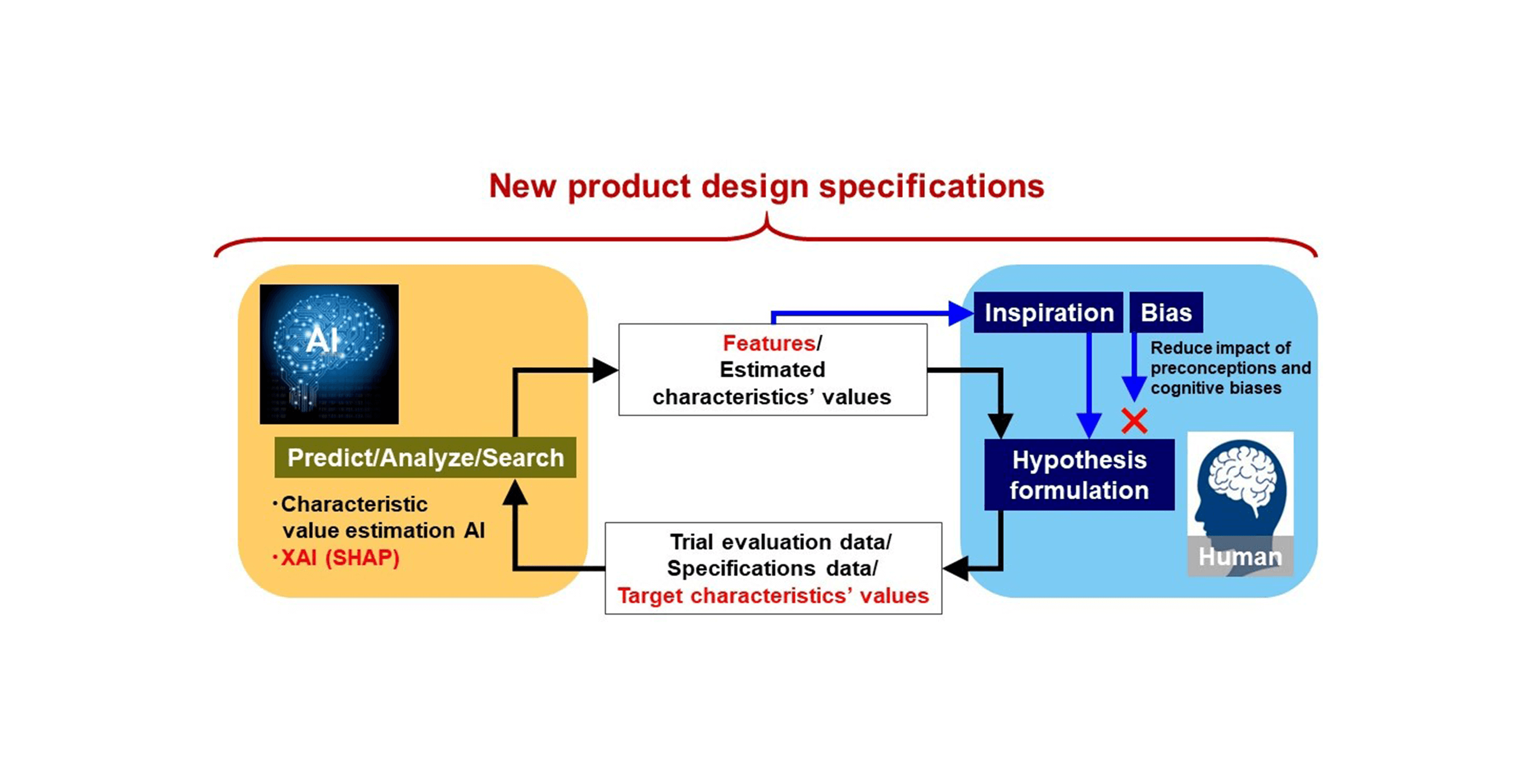
XAI uses the standard specifications and targeted characteristic values set by development staff to determine the targeted characteristics that need to be improved and related quantitative values, and it then presents the features that will be useful to improving the targeted characteristics. Development staff then interpret the information presented by XAI (features that can be useful for realizing the desired tyre characteristics) from multiple perspectives and modify the specifications. The staff then apply the characteristic value estimation AI developed by YOKOHAMA in 2021 to check whether each characteristic value is achieving the targeted level. Final specifications are determined after repeating this process, and XAI is able to confirm the basis for each of these specifications – the design factors (features) that help improve or maintain each characteristic value and its contribution rate. This collaborative effort between humans and AI generates new discoveries and inspirations that will lead to the development of products with higher performance levels.
YOKOHAMA plans to use this system to develop a wide range of tyre products and broaden the applicable areas of its HAICoLab.
HAICoLab is a framework that aims to realize digital transformation by merging the unique inspiration and creativity of humans with AI’s enormous data processing capability. The resulting human-AI collaborations enable people to interpret, analyse, and judge AI-generated results without being trapped by preconceptions and cognitive biases by incorporating perspectives from outside from their own field of expertise and opinions different from their own that supplement their own extensive experience, knowledge, and assessment criteria. YOKOHAMA’s efforts to use HAICoLab in its tyre development include the development of an AI system that predicts the physical property values of rubber and the values of key tyre characteristics (2021) and an AI system that it is using to generate rubber compounds (2022). In addition, to facilitate the use of HAICoLab in other areas, YOKOHAMA recently began using dotData, a general-purpose AI tool that does not require programming.
YOKOHAMA aims to use data generated by HAICoLab to develop innovative products, processes, and services. Through such efforts, YOKOHAMA will contribute to the realization of “Society 5.0”, a future society that will enhance people’s experiences and take advantage of innovative technologies such as AI and IoT, as advocated by the Japanese government’s Cabinet Office.
In May 2024, YOKOHAMA’s R&D using HAICoLab was recognized by the 36th annual Society of Rubber Science and Technology, Japan Awards.